Yolandi and Jake’s father-daughter relationship
All My Puny SorrowsYolandi and Jake’s father-daughter relationship is shaped by a home that disappears, a father whose private grief is difficult to reach, and a death that returns in the daughter’s memory as both a family rupture and a formative image. Yolandi recalls Jake through scenes in which she watches him: standing beside the house he built, looking toward the place it once occupied, and appearing in photographs that preserve an ordinary tenderness she cannot recover in person.
A home built and lost
Jake built the family’s house when he and Lottie were barely twenty, newly married and full of energy. In Lottie’s account, the young couple ran through the sprinkler in their front yard after the day’s work, unconcerned with the disapproval of older neighbors. Years later, Elfrieda gave the memory a more glamorous name, calling it her parents’ La Dolce Vita moment and the sprinkler their Trevi Fountain. For Yolandi, the story establishes a family beginning in which Jake’s house is more than a building: it is the place he made for a young family and the setting for her parents’ early happiness.
That attachment becomes visible when the house is taken away on a truck in the summer of 1979. Yolandi stands in the street with Jake, Lottie, and Elfrieda as the low bungalow travels down First Street and out toward the highway. Elfrieda keeps saying that she can still see it, until the house is finally out of sight. Yolandi asks Jake where it is going. He shields his eyes from the sun and says he does not know; the narration adds that he did not want to know. The exchange is brief, but its uncertainty belongs to the loss itself: Yolandi asks for an answer, while her father remains fixed on what has vanished.
The father in the empty space
The family’s displacement is not Jake’s choice. A car-dealership owner pressures him to sell the property for an expansion, and Jake eventually gives in. The sale leaves him with a persistent sense of guilt and the feeling that resisting would make him a sinner. The community’s religious ideals and commercial interests have become entangled, so his wish to keep his own home is made to seem morally suspect. Lottie urges him to fight, and Elfrieda tries to organize a petition, but neither effort changes the pressure bearing on him.
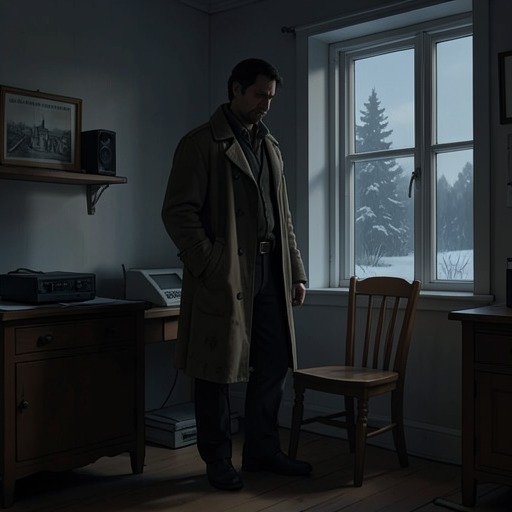
After the move, Jake can sit in his lawn chair at the new house and see through the trees to the empty spot where the old one stood. Yolandi remembers him remaining there, looking at that absence, while the family waits in the car. Lottie eventually honks the horn softly—not to startle him, but to draw him back toward them. This small gesture gives the scene its shape: Jake’s attention is absorbed by the lost home, and the family tries, gently, to bring him back into its company. Yolandi does not describe a direct explanation between father and daughter; instead, she records where he looks, how long he remains, and how someone calls him back.
The move also changes the emotional atmosphere of the household. Lottie becomes restless and dreamy; Jake slams things around in the garage. Yolandi describes herself roaming the outskirts of town, while Elfrieda begins devising a mark to make herself more visible. The passage places Jake’s distress among the family’s different responses to the same rupture. His anger appears in the garage, away from the others, while Yolandi’s recollection preserves the earlier image of him standing in the road after the house has gone.
Family memory and distance
A later photograph gives Yolandi another view of her father: Jake watching Will play Little League baseball, wearing his big glasses, arms crossed, and smiling. The image catches him relaxed at a particular family moment, rather than defined solely by the loss of the house or the death that follows. Yolandi notices the photograph while staying in Lottie’s apartment and looking at the family pictures around her. Her attention to its date—two months before Jake died—places that ordinary smile beside what she knows came next, without diminishing the life visible in the picture.
The photographs also place Jake within a widening family across generations. Yolandi sees an image of Lottie with newborn Nora, their eyes meeting as if they were exchanging secrets, and another of Elfrieda performing in Milan. Jake’s photograph is part of this intimate archive, but it is also the one whose proximity to his death gives it particular weight. Yolandi remembers not only her father as the man who built a house, but as someone watching a child’s game and smiling. The relationship survives in such glimpses, gathered by a daughter who is looking for meaning in the traces her family has kept.
Death and its return
Jake dies beside the railway tracks, and Yolandi’s memory of the days before his death becomes one of the ways that loss continues to enter her present. She recalls humming the refrain that every little thing would be all right and singing herself to sleep in the days before he knelt in the path of a fast-moving train. The recollection joins a child’s attempt at comfort to the knowledge of what is about to happen. Its force lies in the gap between the soothing words and the death that follows, not in any claim that the child could have understood or prevented it.
After Jake’s death, the police return his belongings to Lottie in a bag. His glasses have somehow remained intact until she takes them out, when they crumble in her hands; his watch is also damaged. His wedding rings are battered, and nearly all of his two hundred and six bones are broken. Yolandi remembers these details as material evidence of a death that the family must try to comprehend. The watch makes time feel breakable, while the glasses connect the ruined objects back to the father in the photograph, looking on as Will plays baseball. Jake’s seventy-seven dollars are used for Thai takeout, an act that brings the stark aftermath back to the continuing demands of family life: even in mourning, the living still have to eat.
Across these memories, Yolandi and Jake’s bond is conveyed through witnessing rather than through a record of long conversations. She watches him lose the house he built, notices his gaze fixed on its former site, remembers his smile in a photograph, and carries the timing of his death in a childhood refrain. These recollections do not resolve the distance between what a daughter sees and what a father suffers. They show how that distance becomes part of the relationship: Jake remains present to Yolandi through the places, gestures, images, and damaged belongings that give her memories their shape.